CHAAT
North India
VADA
Mumbai
DOSA
South India
ROLL
Kolkata
01
One country. Hundreds of regional flavours.
The Street Food Story
India doesn’t just
serve food.
It performs it.
Indian street food is an experience of sound, smell, colour and
movement. A vendor works quickly over a hot griddle. Oil crackles in
a deep wok. Chutneys are spooned onto a plate. A customer takes the
first bite while the next order is already being prepared.
What makes India’s street food especially fascinating is its regional
character. The snacks found in Delhi are not identical to those found
in Mumbai, Kolkata, Amritsar, Hyderabad, Bengaluru or Chennai. Even
familiar foods can change their names, fillings, chutneys and spices
as they travel from one region to another.
The best street-food memories often begin with a simple question:
“What are they cooking over there?”
02 / CHAAT
Pani Puri.
One bite.
Chaos.
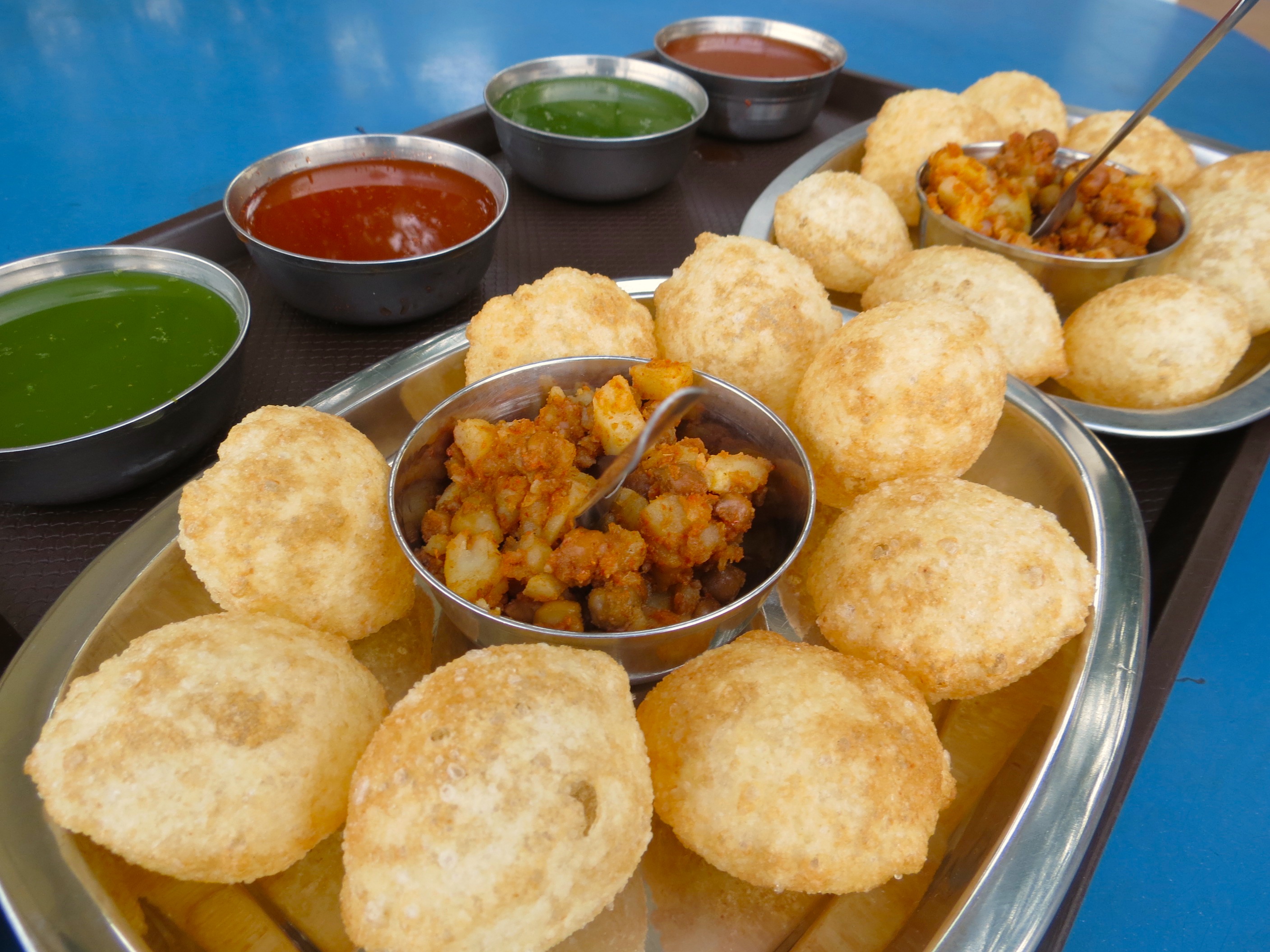
Pani puri is built around contrast: a crisp hollow puri, a spiced
filling, tangy and spicy water, and often a sweet chutney. The result
is small, quick and intensely flavoured.
Across India, closely related versions are known by different names,
including golgappa and puchka. Their precise preparation varies by
region and vendor.
Golgappa
Puchka
Pani Puri
03 / DELHI
Where the lanes
smell like lunch.
Delhi’s street-food culture is closely associated with the busy lanes
of Old Delhi and places such as Chandni Chowk. Chaat, parathas,
samosas, kachoris, aloo tikki and chhole bhature are among the foods
visitors encounter in the city’s food culture.

CHANDNI
CHOWK
One of Delhi’s historic markets is also known for its food lanes,
where old culinary traditions meet the rhythm of a modern city.
04 / MUMBAI
The Mumbai
Burger.
Vada pav is one of Mumbai’s best-known street foods: a fried potato
fritter tucked inside a pav and commonly served with chutneys and
chilli.
Its appeal is simple. It is compact, inexpensive-looking, bold in
flavour and made for eating on the move. In a city famous for its
speed, vada pav fits naturally into the rhythm of everyday life.
POTATO + PAV + CHUTNEY


HOT TAWA. CRISP DOSA.
05 / SOUTH INDIA
Watch the
tawa artist.
Few street-food sights are as satisfying as dosa batter spreading
across a hot tawa in a perfect circle. The batter is traditionally
made from fermented rice and black gram, and the dosa can be served
with accompaniments such as chutney and sambar.
South India’s street-food and breakfast traditions demonstrate how
technique can be as important as ingredients. A skilled vendor can
spread, crisp, fold and serve a dosa in moments.
Rice
Black Gram
Sambar
06 / KOLKATA
Roll it.
Wrap it.
Walk.
Kathi rolls are closely associated with Kolkata and have become a
familiar Indian street-food format. A flatbread wraps a seasoned
filling, vegetables and sauces into a portable meal.
It is street food designed for movement: something you can hold in one
hand while navigating a busy market or city street.


07 / SWEET STREET
Jalebi:
the sweet
spiral.
Watch the batter being piped into hot oil and suddenly the street
becomes a theatre. The thin spirals fry until golden before being
soaked in sugar syrup.
Jalebi is one of India’s most recognizable sweets and is commonly
associated with markets, festivals and celebrations. Freshly fried,
warm jalebi has a crisp exterior and syrupy sweetness.
Some street foods are meals. Jalebi is a reward.
MORE THAN FOOD
The street is part
of the recipe.
Street food tastes different because the surroundings are part of the
experience: the vendor, the queue, the smell of spices, the noise of
traffic and the people sharing the same small space.
🔥
Fresh off the tawa
Many street foods are prepared directly in front of you and served
hot.
🌶️
Bold flavours
Chutneys, spices, herbs and pickles create layers of flavour in even
the smallest snacks.
👨🍳
The vendor matters
Speed, technique and familiarity with local tastes are part of the
craft.
🥘
Regional identity
A snack can tell you something about the city, community and
ingredients around it.
A QUICK FOOD MAP
Follow the flavours.
NORTH
Delhi & Punjab
Chaat, samosas, kachoris, parathas, chhole bhature and kulchas.
WEST
Mumbai & Gujarat
Vada pav, bhel puri, sev puri, pav bhaji, fafda and jalebi.
EAST
Kolkata & Bengal
Kathi rolls, puchka, jhalmuri and a wide range of sweets.
SOUTH
South India
Dosa, idli, vada, bonda and many regional snacks and breakfast foods.
BE A CONSCIOUS FOOD TRAVELLER
Eat with curiosity.
Travel with respect.
Street food is part of local life. When exploring food markets and
roadside stalls, respect vendors and other customers, avoid unnecessary
waste, keep the surroundings clean, and be mindful of food allergies and
dietary requirements.
Keep Streets Clean
Respect Vendors
Try Local Flavours
FINAL BITE
India’s street food
is a story you can eat.
It is found in crowded markets, quiet neighbourhoods, railway stations,
college areas, beach roads and historic lanes. It belongs to mornings
and late nights, quick lunches and leisurely conversations.
From the crackle of a samosa to the splash of pani puri water, the
sizzle of a dosa and the golden swirl of jalebi, India’s street food
turns ordinary moments into memorable ones.
EAT • EXPLORE • EXPERIENCE
Image Credits
The photographs used in this article are from Wikimedia Commons.
Check the individual file pages for the photographer, exact license
terms and attribution requirements before publishing the page.
-
Street Chaat Stall — Shreya13jain —
Creative Commons Attribution-ShareAlike 4.0 -
Pani Puri / Gol Gappa — Apoorva Jinka —
Creative Commons Attribution 2.0 -
Vada Pav — Rutvi Mistry —
Creative Commons Attribution-ShareAlike 4.0 -
Dosa — Adib95 —
Creative Commons Attribution-ShareAlike 4.0 -
Jalebi Frying — Kondephy —
Creative Commons Attribution-ShareAlike 3.0 -
Kathi Roll — Amanwiki308 —
Creative Commons Attribution-ShareAlike 4.0
0 Comments